Cameron Winter - Cabaret Sauvage - 03/12/2026
Dernière mise à jour : 13 juil.
The pathway to the Cabaret Sauvage is poorly lit. On the edge of the docks lies a sentiment of confidentiality; only a select few will be lucky enough to go in and leave with a new shared, almost secret, experience. It’s how I imagine walking into Cabaret’s Kit Kat Club in the 1930s would feel. You’re walking into the dark, knowing that something transformative is about to occur. You want to talk about it to anyone who crosses your path, but also wish to keep it just for yourself.
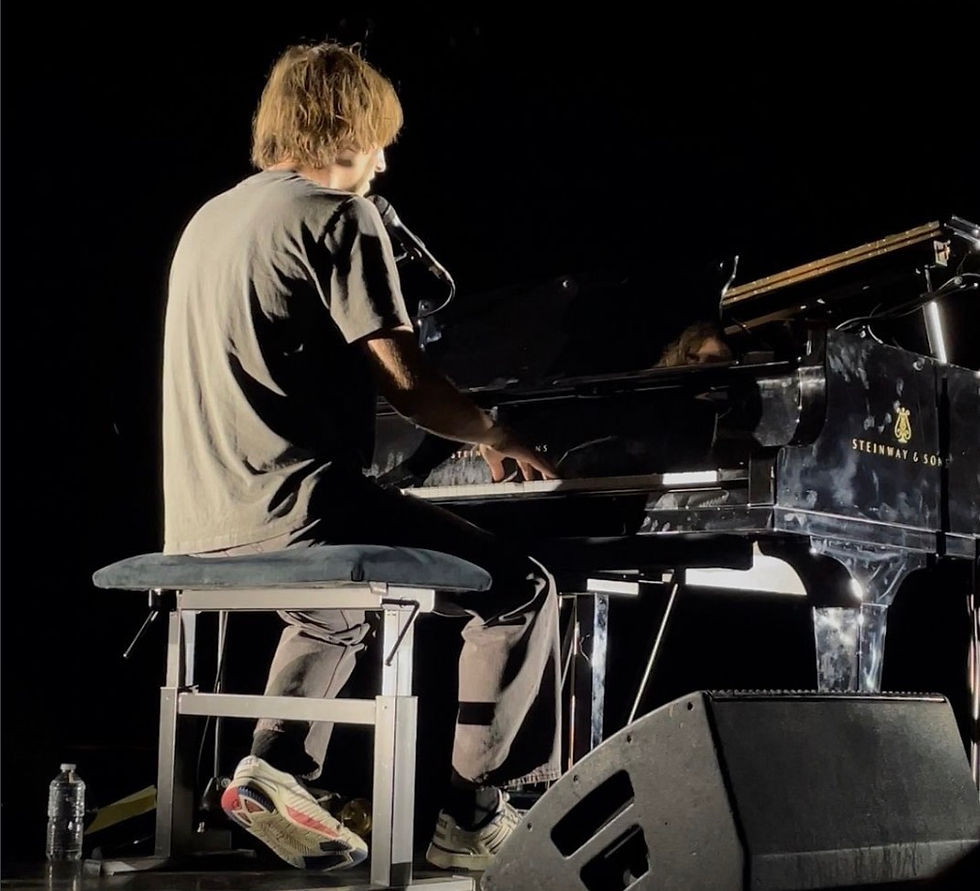
With its marquee and red and orange-stained glass, the venue resembles a holy circus, ready to welcome the most bizarre acts. Cameron Winter’s piano is already dominating the stage, and it’s hard to imagine it hasn’t always been there, rooted to the parquet board. Its immensity makes me believe it has seen into the mouth of what it is to be a mountain.
At 8:30 steps from behind the red curtains a bashful Pagliacci. Shuffling through the papers lying at the foot of his piano, he resorts to using the cheat sheet covered in lyrics. Indeed, Cameron Winter has decided to start the festivities with a song he’s never played live before. « I’m coming home », he cries to an already entranced audience, who doesn’t need much more than a single sentence.
When he plays the songs that have already become classics (Love Takes Miles having been recently named Pitchfork’s 2025 best song), you can feel that everyone knows the word yet stays silent. There’s something too special in the air for us to change anything about it, and it seems we’ve tacitly agreed to collectively hold our breath. Between hymnals that have been the cause of many tears, such as Try As I May or Cancer of the Skull, and a few unreleased tracks (the heartbreaking I Will Let You Down, a great indication of his love for Nina Simone), Cameron Winter doesn’t allow any respite.
Drinking Age is the emotive climax of the night. Somewhere in the crowd, someone cries, and the others sympathise. « Today I met who I’m gonna be », he wails, his dishevelled double in front of him, in the reflection of the piano.
If you’ve listened to Cameron Winter’s work, you know how uniquely profound and touching his voice is. Yet it is impossible to be prepared for how it will sound coming from a microphone standing in front of you. I’m convinced he has discovered frequencies previously unknown to men, and is making the best use of them.
The piano seems to be an extension of him, one from which he has trouble separating from. His interactions facing the crowd are scarce, but it’s not what the crowd is looking for tonight anyway.
« Paris is cruel », he says. But tonight, Paris is a tamed creature that is eating right out of the New Yorker’s Palm of hand.
After the immense O$ in which Cameron Winter proclaims that God is real (in that moment, no one doubts it), a standing ovation and a brief interlude in French (during which he told the audience he had learned to speak French thanks to our very own version of Hell’s Kitchen), he embarks on one final song. The wobbly attempt of the French start for Take It With You elicits some caring laughter and gasps, but it isn’t enough to make the song any less tragic.
Everyone seems to be reluctant to leave the venue. People stay in front of the stage, hoping for an encore but also trying to make sense of what just happened. Friends gather in front of the bar and the merch table. We all try to cling to something, hoping to somehow find a way to delay the moment we have to stop out into the could and admit that the show is done. From the 1200 people in the venue that night, there are probably only approximately ten people that I will see and talk to again. But I’ll forever share with every single one of them the feeling of having witnessed something special.


Commentaires